The scribe I run, and which one I'd tell you to buy.
There’s no single best veterinary AI scribe. The best one is the one that writes into your practice software without copy-paste, in words you’d sign. If your PIMS has a scribe built in, try that first. If not, buy one that connects to your PIMS. Build your own only if you already build things.
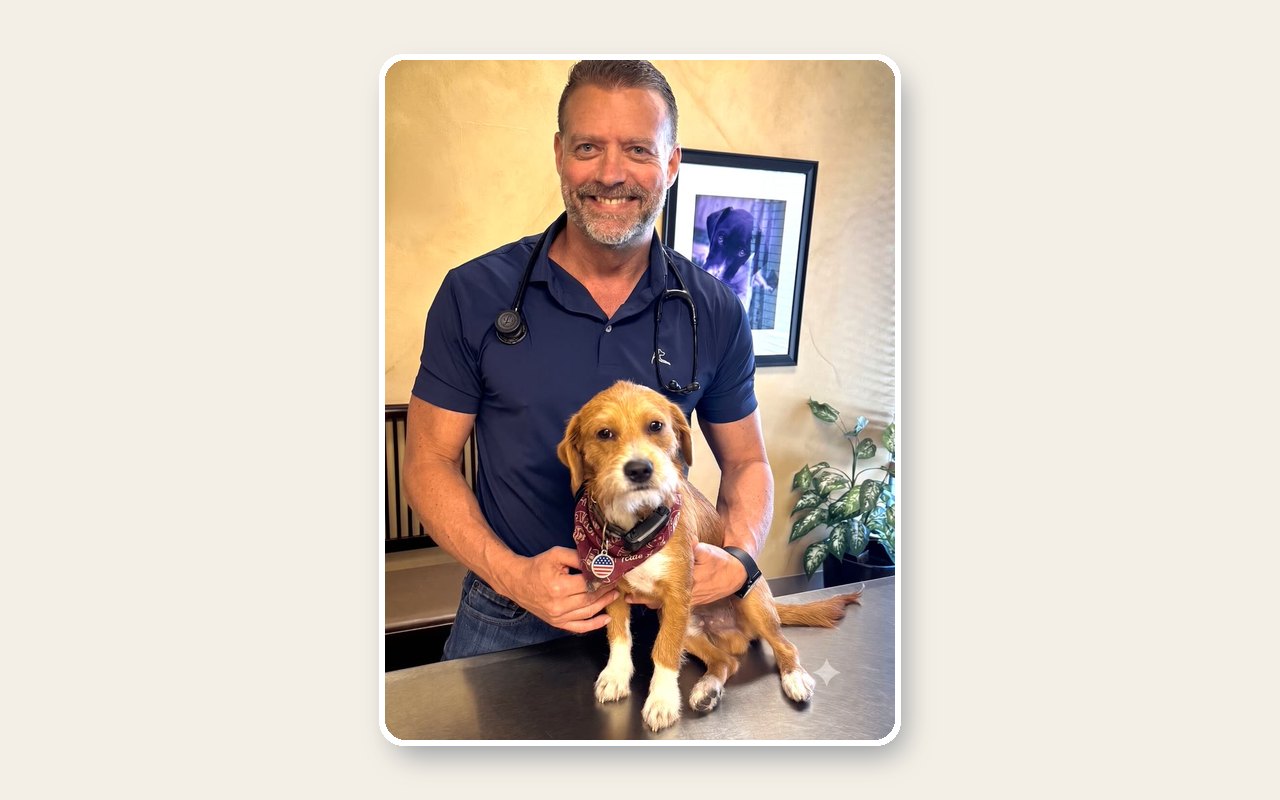
That’s the honest answer, and it’s not the one the comparison posts give you. Most of the “best AI scribe” lists out there are written by an AI scribe company, and guess who wins. I’m a solo vet in Cypress, just outside Houston, and I run one I built myself, called Hearthstone Scribe.
To be clear up front: I’m not selling it, and it isn’t something I could sell. It’s built around my clinic, my software, and the way I talk. It’s here as an example of what you can build yourself for your own needs. This is what I needed.
So this isn’t a ranking. It’s what I’d tell a friend who owns a clinic and asked me over lunch which one to get. Nothing here is sponsored, and no company in this post pays me anything.
Which veterinary AI scribe should I buy?
Start with your practice software, not the scribe.
Here’s the short version by situation:
- Your PIMS has its own scribe built in (Shepherd has TranscribeAI, Digitail has Tails, Instinct now owns ScribbleVet). Try that one first. It already knows where the note goes, and that’s the hardest part.
- Your PIMS doesn’t, and you just want notes done. Scribenote has a free plan. CoVet and Talkatoo have cheaper tiers. Run a two-week trial on your real Tuesday, not a demo.
- You’re a busy multi-doctor practice that wants the note in the record with no copying. Look hard at whoever has a direct two-way connection to your PIMS. VetRec, HappyDoc and ScribbleVet each connect directly to different PIMS. Check the list for yours.
- You build software already, or you’ve started to. Then building your own can make sense. That’s me. It’s not most people, and I’ll say why below.
If you’re the one sitting in the office for two hours after close, writing up records and trying to remember exactly where that mass was on a dog you saw seven hours ago, just get one. Personally, I’d go with CoVet. I think it’s one of the better ones for most doctors. You just have to get in the habit of using it.
Once you do, and you see how much easier it makes your life, it really does change. You can go back through the list of cases you saw that day, and even if you don’t use the note, you go, “Oh yeah, I remember that,” because you said your exam out loud. Exactly where the masses were. Which ear was infected, right or left. Otherwise you’re never going to remember all of it. It saves a lot of time, but more importantly, your records are just more thorough.
What AI scribe do I use in my own clinic?
I use Hearthstone Scribe. I built it, and it runs on a small server in my clinic.
It does one thing. I talk through the exam the way I always have. It drafts the SOAP note and the discharge, then pushes both back into Shepherd, my practice software. I read what landed. That’s the whole loop.
I went this way because of where the note ends up. I tried the scribes that came across my desk, CoVet and ScribbleVet among them. They handed me a note. What I wanted was the note put into Shepherd as the record itself, with the discharge sitting next to it, without me pasting anything. So I built the version that does that.
CoVet does connect to Shepherd. But when I looked at it, the connection was going to cost about $100 a month on top of what I was already paying, and the note didn’t land in Shepherd’s SOAP template. It got dropped in as a plain note attached to the record. Mine fills in the actual SOAP fields in Shepherd. For me, that difference is the whole point.
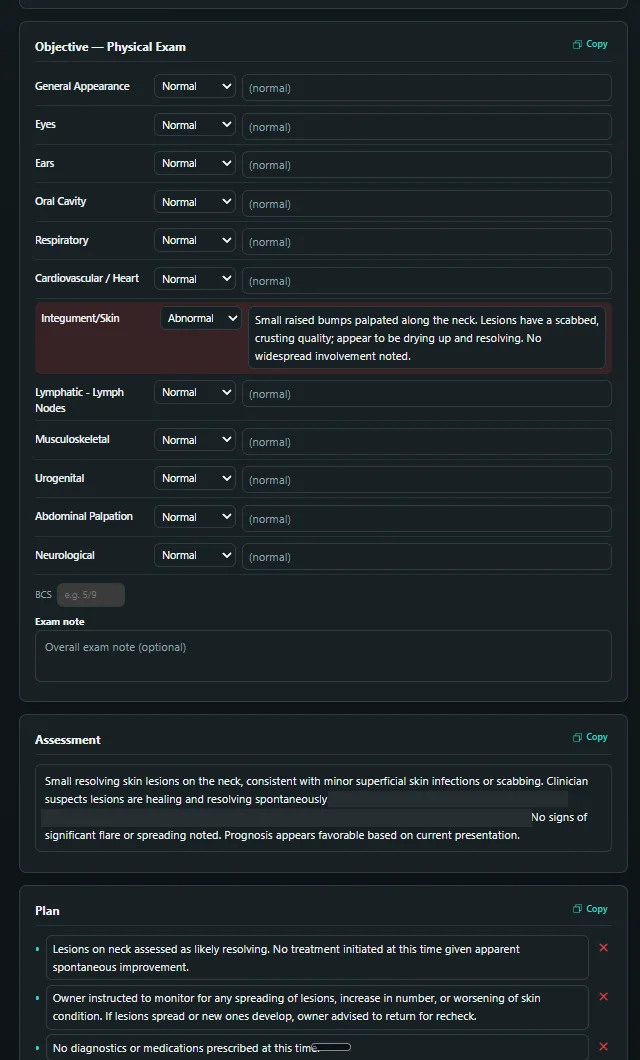
I also tried Shepherd’s own TranscribeAI. Honestly, it was fine. A little slow and a little clunky, but the note did go into the record. Two things kept me building my own. The discharge instructions didn’t sound like me, and mine read a lot better to clients. And it missed a lot of the physical exam abnormalities, so they didn’t get marked in the SOAP. That second one matters more than it sounds, because a scribe that defaults to normal can quietly leave a finding out of the chart.
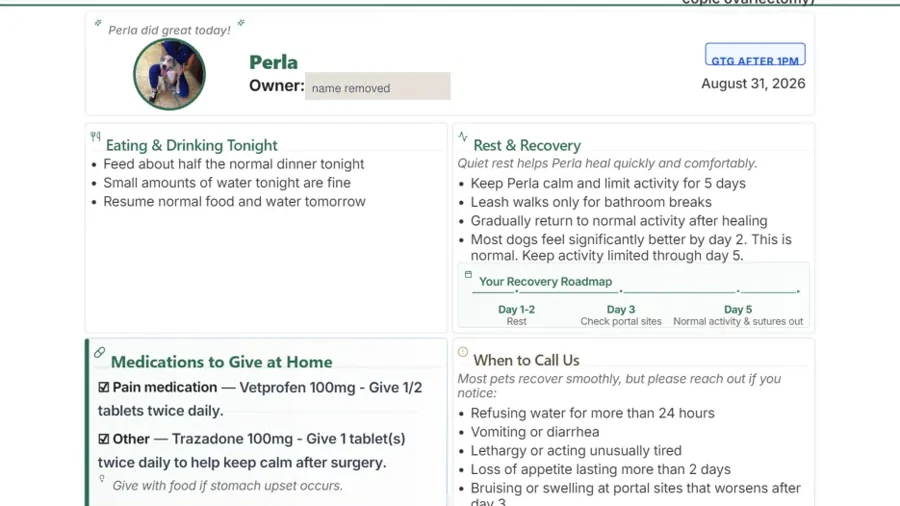
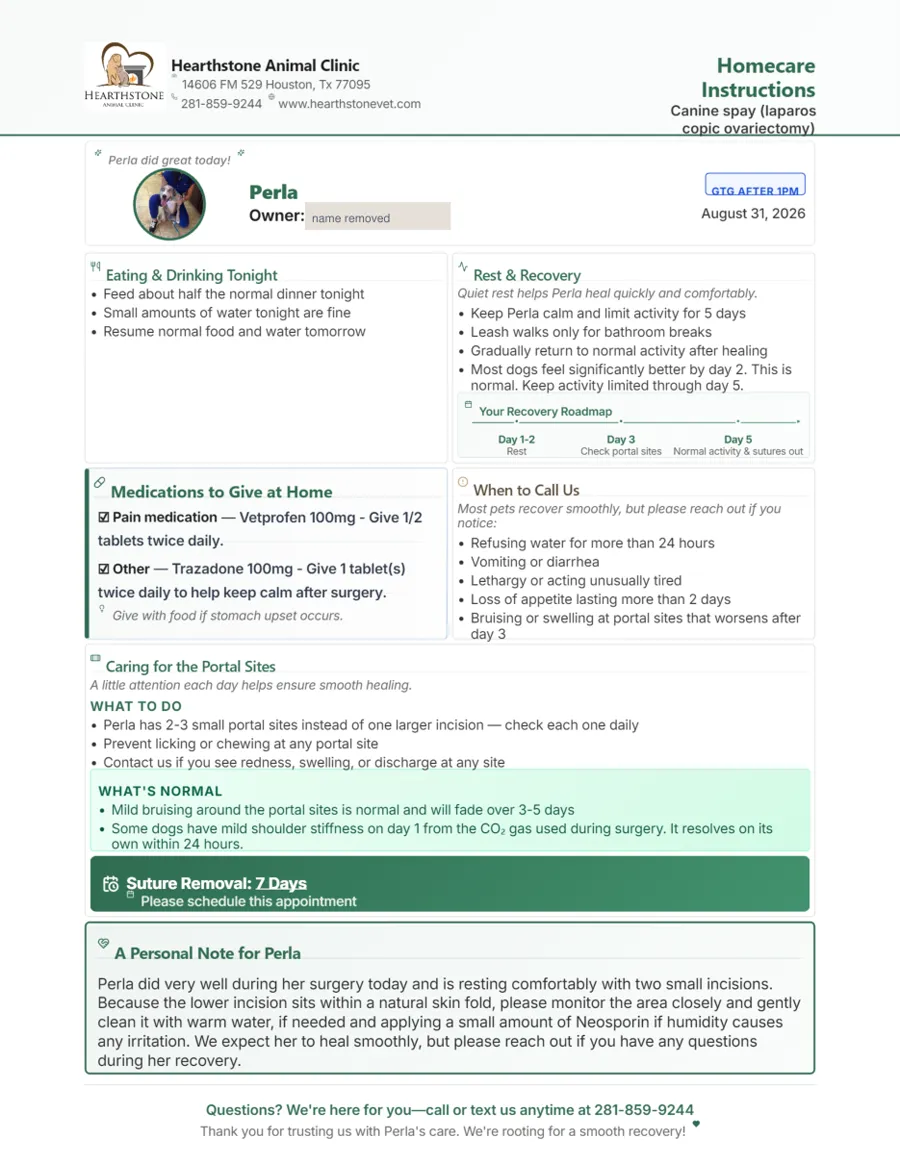
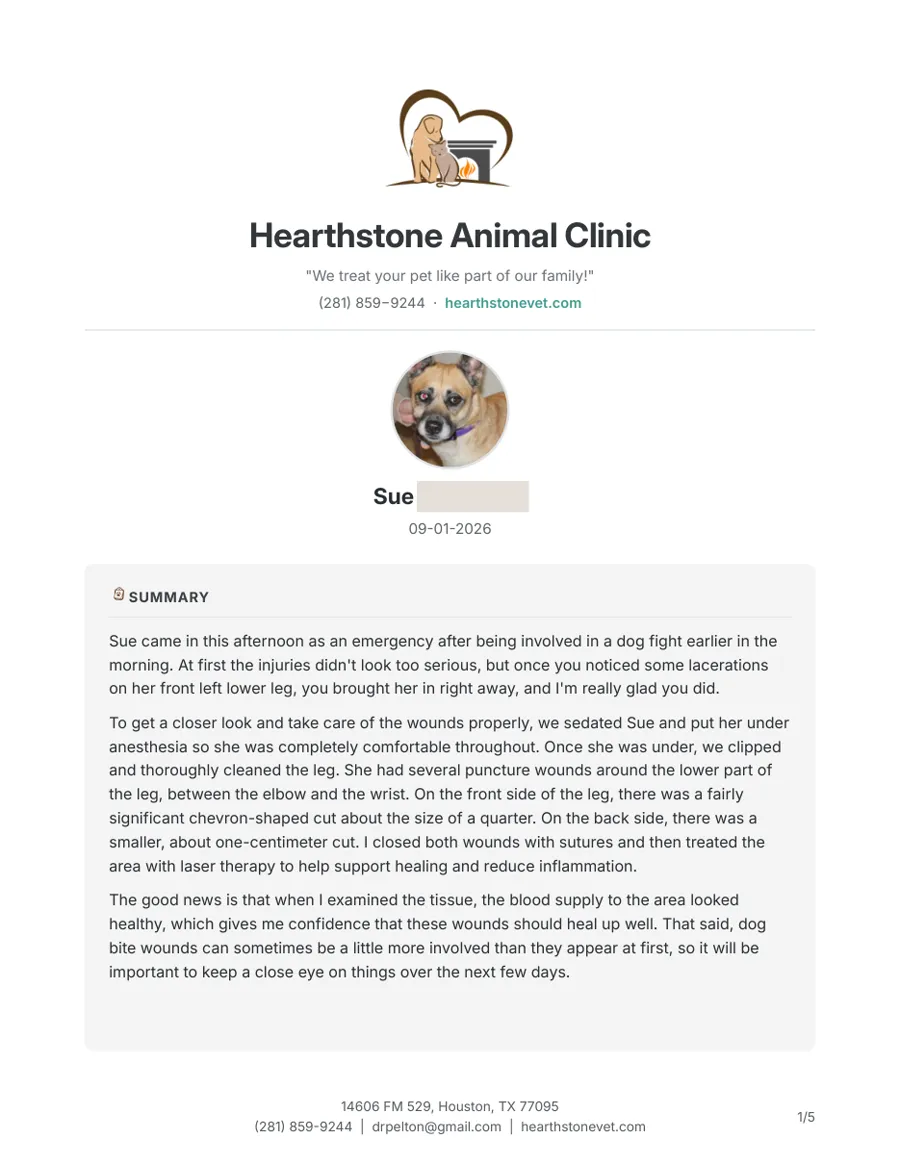
It isn’t smarter than the commercial ones. It just knows how my clinic works: one doctor, a small team, one piece of software. If you want to see what it actually produces, I published a real five-page emergency discharge it wrote, for a dog after a dog fight, with the owner’s name taken out of the file. It’s on the real paperwork page.
How does an AI scribe work day to day?
Nothing fancy. Here’s a normal appointment.
- From the treatment room, I open my scribe’s web page and hit a button for “exam room 1” or “exam room 2.” Recording starts in that room. I don’t carry a phone in or touch anything in front of the client.
- I do the exam and talk to the owner like normal. I say my findings out loud, which I mostly did anyway. When I’m done, I hit stop.
- It filters out the small talk, keeps the medical parts, and drafts the note and the owner’s discharge. Two documents, written two different ways. The note is for me and the next doctor. The discharge is for a worried person who isn’t medical.
- A Chrome extension puts both into Shepherd, into the actual SOAP fields, the same way a person typing would. Before anything goes in, I get a preview of exactly what it’s about to put in the chart, and nothing is entered until I hit send.
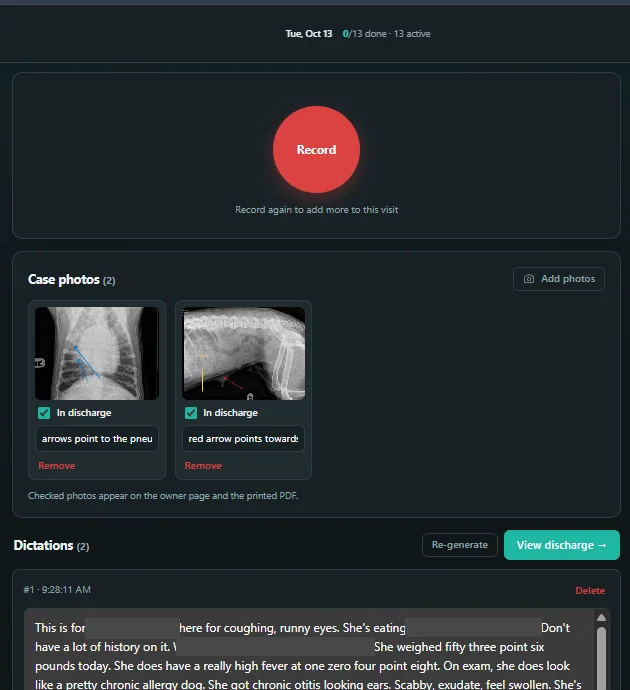
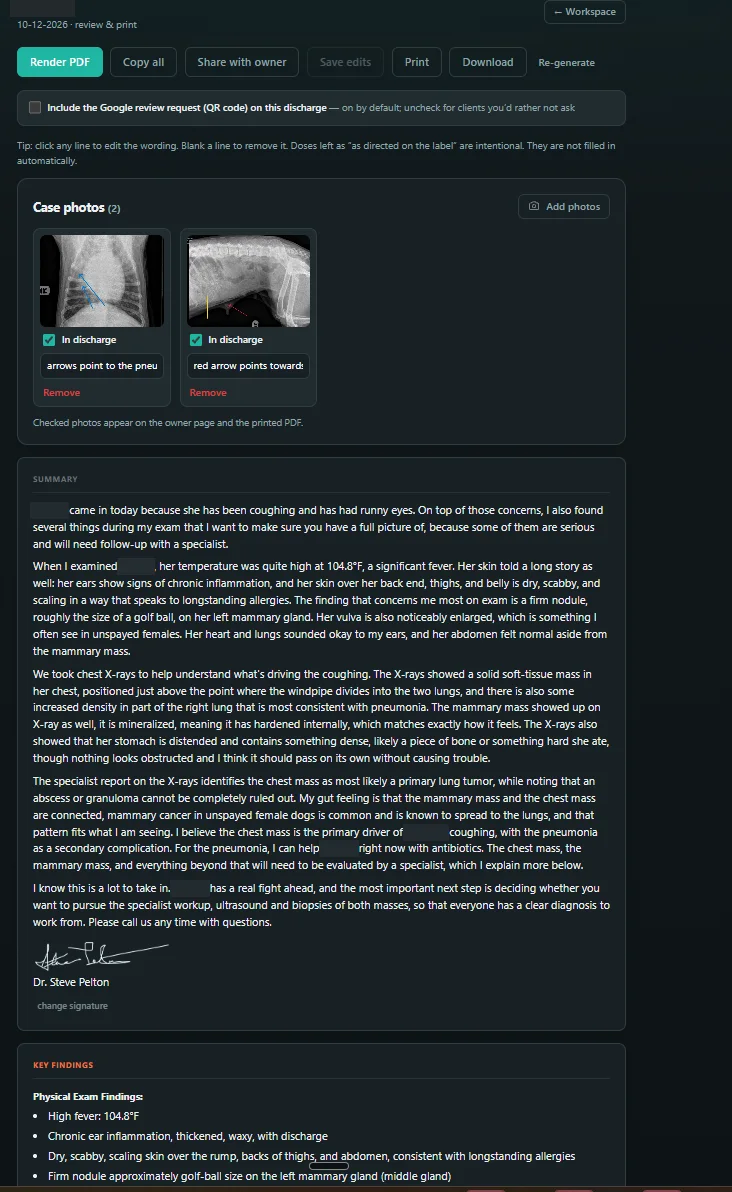
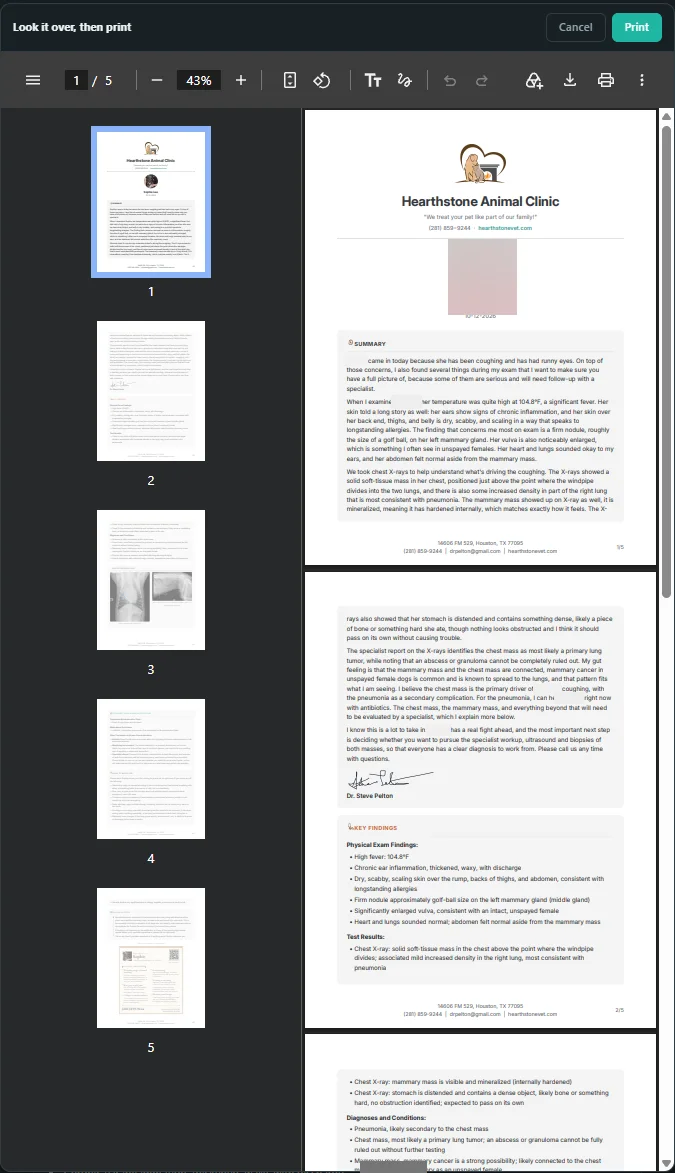
The time I get back is mostly the discharge. I wrote about that in how I write discharge instructions with AI. It’s ten to fifteen minutes per discharge, every discharge, and on a solo day that’s lunch or no lunch. A typical day for me is 10 to 15 cases in the morning and usually 4 to 8 wellness appointments in the afternoon, so it adds up fast.
What should I look for in a veterinary AI scribe?
Six things, in the order I’d care about them.
1. Does the note land in your PIMS, or just near it?
This is the one that matters most and gets checked least. There are three levels.
- Built into the PIMS. The note goes straight into the SOAP fields. Shepherd’s TranscribeAI and Digitail’s Tails work this way.
- Direct connection. The scribe pulls today’s appointments from your PIMS and sends the note back with one click.
- Browser extension or copy-paste. It works next to any PIMS. You still move the note yourself, or an extension fills the fields for you.
The third one isn’t bad. Plenty of vets are happy with it. Just know which one you’re buying, because “integrates with your PIMS” on a website can mean any of the three.
2. Accuracy on vet words
Drug names, breeds, “BAR,” “grade 2 of 6 left apical murmur.” Every vendor says it’s tuned for veterinary medicine. Test it anyway. Say the weird drugs you actually use. Say a breed nobody spells right. See what comes back.
3. Does it write a discharge you’d hand to an owner?
A SOAP note is half the job. Ask whether it writes the owner’s go-home sheet too, and read one. It should sound like you, at a reading level an owner can follow, with clear “call us if” lines. If it reads like a pamphlet, you’ll rewrite it, and you’ve saved nothing.
4. Where does the audio go?
You’re recording clients in your exam room. Find out where that recording is stored, how long it’s kept, and whether it’s used to train the company’s AI. Some vendors say plainly that they don’t. At least one says in its privacy policy that it may. Read the actual policy, not the sales page. Veterinary records aren’t HIPAA, but that doesn’t mean anything goes. I wrote more on that in is it safe to put patient records in an AI chatbot.
5. Price, and what “per DVM” means
Most charge per doctor per month and let techs and front desk on free. Some charge a flat clinic rate. Some cap how many notes you get. A cheap plan with a note cap can get expensive on a busy week.
6. How long do you spend fixing the note?
This is the real cost, and no website lists it. If you spend four minutes editing every note, the scribe isn’t saving what you think. Time yourself for a week on your trial. Then decide.
How do the major veterinary AI scribes compare?
This is what each company says publicly, pulled from their own sites on October 12, 2026. Prices are in US dollars. I haven’t used most of these in my clinic, so this is facts, not reviews. Prices and integrations change fast, so check before you buy.
| Scribe | What it is | Works with Shepherd? | Public price (US) | What they say about your data |
|---|---|---|---|---|
| Shepherd TranscribeAI | Built into Shepherd PIMS. Writes into SOAP fields, with a review step before saving. Works in full and Quick SOAP. | Built in | Not listed separately | Not reviewed for this post |
| ScribbleVet | Standalone scribe. Bought by Instinct Science (Instinct EMR, Plumb’s) in January 2026. | Not listed on its site (names Instinct, ezyVet, Vetspire, Pulse) | Essential $40/user/mo for 150 notes. Unleashed $150/DVM/mo annual, $200 monthly. Support staff free. | Privacy policy says it may use portions of recordings to train its AI models |
| VetRec | Standalone scribe plus phone notes and records recap. | Yes, via Chrome extension (direct connections for others, like Instinct and ezyVet) | $99/vet/mo annual, $150 monthly. Unlimited support staff. 14-day trial. | Says no training on your data. SOC 2 Type II. Custom retention. |
| HappyDoc | Scribe plus assistant. Focus on AVImark and Cornerstone. | Via browser extension | From $119/mo, unlimited users. 60-day money-back guarantee. | Not reviewed for this post |
| Scribenote | Standalone scribe. Has a free plan. | Not named; exports through its PIMSPal and Widget Mode tools | Free plan. Pro $79/DVM/mo annual, $99 monthly. | Data stored in US data centers. Deleted after account deletion or 6 months inactive. |
| CoVet | Scribe plus AI clinical chat. | Yes, listed: imports Shepherd appointments, exports finished documents back | Essentials $550/yr (100 notes/mo). Unlimited $99/mo ($1,188/yr). Free for support staff. | Says no training on user data. ISO 27001, SOC 2 Type 2. |
| Talkatoo | Dictation plus AI SOAP notes. | Works in any text field; no direct connection needed | SOAP Notes $40/user/mo annual ($50 monthly). Ultimate $99/user/mo annual ($119 monthly). 30-day money-back. | Not reviewed for this post |
| Digitail Tails | Built into Digitail PIMS. Free standalone app (Tails VIP) for non-customers. | No sync outside Digitail | Standalone app free. Included in Digitail Growth plans. | Not reviewed for this post |
A few others show up in 2026 buyer guides too, like PetDesk Scribe, VetSkribe and Heidi. I didn’t dig into those for this post.
A note from my own trial: CoVet’s Shepherd connection is real, but in my clinic the output went in as a general note rather than into the SOAP template, and it was going to add about $100 a month to my bill. Ask any vendor to show you exactly where the note lands in your PIMS before you sign. “Integrates with” can mean very different things.
ScribbleVet, I just wasn’t impressed with. The screens felt like a lot of friction, and the output wasn’t very good. That was about four months ago, so it may have changed since.
Should I build my own AI scribe or buy one?
Most clinics should buy one. I mean that.
Here’s what building cost me, honestly. Not money, mostly. Time and attention. The audio was never the hard part. Making the note complete was. Early on, a visit I’d only worked up as a discharge pushed just the plan into the record. The exam findings, the history, the assessment, all missing. And the system said “success” every time. I rebuilt it to rebuild the whole note from the transcript, and to tell the difference between me examining a dog and the owner talking about their weekend.
That’s the job when you build your own. You find every one of those yourself, on real patients. A company with a thousand clinics finds them faster than you will.
Build your own if:
- You can get the note into your PIMS. I used a Chrome extension that fills in the record the way a person would, which works with almost any browser-based software. Check your PIMS’s terms of service before you automate anything inside it.
- You already build small tools and enjoy it.
- You want something specific no vendor does, like the discharge written in your voice and filed next to the note.
- You’ll keep a human reading every note. Always.
Buy if:
- You want notes done next week, not next quarter.
- Nobody on your team wants to own a piece of software.
- A vendor already writes straight into your PIMS.
If I were starting over today, I’d absolutely build my own again, knowing what’s possible now, and I’d probably build it ten times faster. But that’s me. That’s not everybody, and I know it.
Where does the data go? The app runs on my own hardware, but the AI part doesn’t stay in the building. The audio goes to Deepgram, which turns speech into text. Then the transcript goes to Anthropic’s Claude through their API, the developer access that’s paid per use, not the consumer chatbot, and Claude writes the note and the discharge. So this isn’t a “nothing leaves the clinic” setup, and I won’t pretend it is. If you build your own, know where every piece runs and read the provider’s data terms.
My rules for anything that touches a real patient are all on one page: my safety rules. The short version is the pet’s record goes in, the owner’s details don’t, and nothing gets to a client without a person checking it.
What do AI scribes still get wrong?
Plenty, and mine got some of these wrong early on. Here’s what I watch for.
- Saying it worked when it didn’t. A “success” message isn’t proof the note is whole. Read what actually landed in the record, every time, until the workflow has earned it.
- Filing small talk as a finding. Without real work, it’ll write the owner’s weekend into the history.
- Filling in normals you didn’t check. Some scribes default every body system to normal unless you say otherwise. Shepherd’s TranscribeAI has that as a setting, on by default. It’s fast. It’s also a note that says you checked the ears when you didn’t. Know which way yours is set.
- Numbers. Doses, weights, durations. AI states a wrong number with total confidence. The dose is always mine, whatever wrote it down.
- Sounding like a robot. If it doesn’t know how you talk, the discharge reads like a brochure.
Is anything still broken in mine? Honestly, no. Right now it works exactly the way I pictured my perfect scribe working. When I need something new, I just add it. When I wanted the case photos in the discharge, we added that. It took two minutes.
None of these are reasons to skip a scribe. They’re reasons to read the note.
Where to go from here
If you’re stuck choosing a scribe, or you bought one and it’s not working, tell me what’s going wrong in the box below. I read every note. Start with the two real discharge sheets my tools produced, and my safety rules for anything that touches a patient. If you’re on Shepherd and wondering what’s possible past the screens, I wrote about building on top of the software I pay for. And everything I’ve built, dead projects included, is on the build page.
Questions I get asked
- What is the best veterinary AI scribe in 2026?
- There isn't one best. The best one writes into your practice software without copy-paste and needs little editing. If your PIMS has one built in, start there. If not, trial two that connect to your PIMS on real appointments.
- How much does a veterinary AI scribe cost?
- Public prices in October 2026 run from free (Scribenote's free plan, Digitail's standalone app) up to $200 per doctor per month. Most full plans sit around $99 to $150 per doctor. HappyDoc lists a flat clinic rate from $119 a month. Most let techs and front desk use it free.
- Does an AI scribe work with Shepherd?
- Yes. Shepherd has its own, TranscribeAI, built in. CoVet lists a Shepherd connection. VetRec and HappyDoc work with Shepherd through a browser extension. Mine uses a Chrome extension that fills in Shepherd's SOAP fields the way a person would. Ask any vendor whether its note fills the SOAP template or gets attached as a separate note.
- Do I need client consent to record the exam?
- It depends on your state. Several vendors suggest a sign in the exam room or a consent line at check-in, and some give you templates. I'm not a lawyer, so check your state's rules. At Hearthstone there's a small card in each exam room saying we may record visits to help write medical notes, like you see in a lot of human medical offices.
- Do AI scribes train on my recordings?
- Some say they don't. At least one says in its privacy policy that it may use portions of recordings to train its models. Read the privacy policy itself, ask where audio is stored and for how long, and get the answer in writing.
- Can an AI scribe write discharge instructions too?
- Many can. Ask for a sample and read it like an owner would. Mine writes the discharge from the same recording as the note, and you can read a real one on the real paperwork page of this site.
Tell me what's broken in your clinic.
If this made you think of a problem you'd fix, I want to hear it.