








How I use AI with real patients
My rules, all in one place.
The most common question I get from other vets isn't "how did you build that." It's "is that safe?" Fair question. These are the rules I follow, and I didn't write them up front. Each one came from building something, finding the way it could go wrong, and deciding that wasn't going to happen in my clinic.
Not legal advice. Just how one solo vet does it, with a link to where each rule actually lives.
- 1
The dose is always mine.
Same as if a calculator, a spreadsheet or a tech did the math. Whatever did it, I read every number before it goes anywhere, and I use common sense. If it looks off, it is off until I've checked it.
Where it shows up: The home page FAQ → - 2
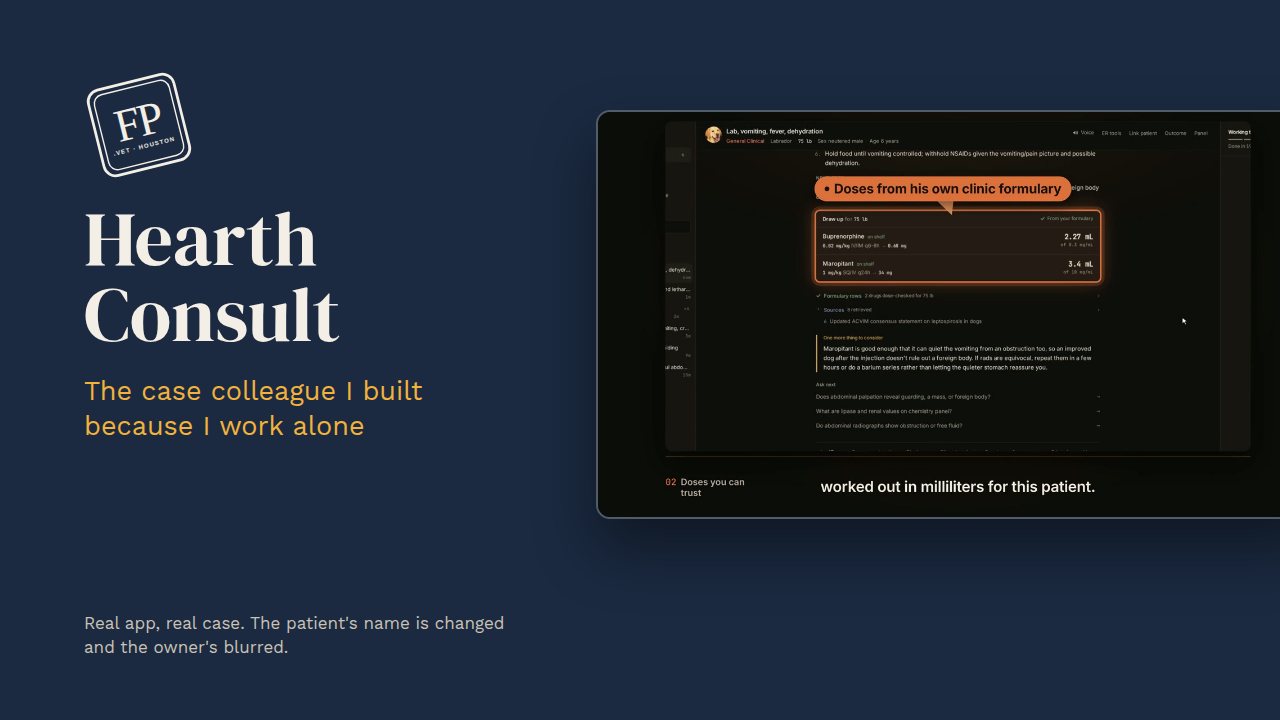
The math happens in code, not in the AI.
AI is good at reasoning through a case and bad at arithmetic, and it'll state a wrong number with total confidence. So doses come from my own formulary, and plain code checks the math. If the words and the numbers ever disagree, the dose gets struck through on screen instead of trusted.
Where it shows up: Hearth Consult → - 3
The pet's record goes in. The owner doesn't.
The history, exam and labs are the whole point, so they go to the AI. The owner's name, phone and address are stripped out first. On my own tools that happens automatically. In a plain chat window, I take them out by hand.
Where it shows up: Is it safe to put records in a chatbot? → - 4
Nothing goes to a client unless a person presses send.
When Ember was drafting replies to our client texts, a person on my team approved every one, and it never sent a message on its own. The text refiner inside BayleeFlow, the screen my front desk runs her day from, works the same way. The AI writes the draft. A human decides it's right and presses send.
Where it shows up: BayleeFlow, on the Built page → - 5
Reading and writing use different keys.
Most of what I build can only read the records, so it can't change them. VetNexus, which does write into my practice software, holds its own key, logs every write with who made it, and never retries a failed write blind, because it might have landed anyway.
Where it shows up: VetNexus and its guard rails → - 6
Every change gets tested on my own dog first.
Before anything writes to a client's chart, it gets tried on Copper's record.
Where it shows up: VetNexus → - 7
The software that holds records lives in my building.
My scribe, my case colleague and my practice software run on a small server in my clinic, not on someone else's cloud. When a chart goes to the AI, it goes without the owner (rule 3). It's also why most of the demos on this site are videos instead of links.
Where it shows up: The demos → - 8
Public demos use made-up patients.
Juniper in the VetNexus video, Rosie in the records summary, Max in the text refiner. None of them are real. Real paperwork only goes on this site with the owner's name removed from the file itself.
Where it shows up: Real discharge sheets, names removed → - 9
A backup before every change, and a way back.
Code that works every single time doesn't exist, from AI or from people. So every change I ship has a timestamped backup and a one-step rollback. Tests and a rollback are the fix, same as for anything else.
Where it shows up: What AI still sucks at → - 10
The AI is a colleague, not the doctor.
It's the person down the hall I can talk a case through with. It's good at catching what I missed and listing what it could be. The diagnosis, the plan and the conversation with the owner stay mine.
Where it shows up: Hearth Consult →
Do you do something I don't?
If your clinic has a rule that belongs on this list, I'd like to hear it. Post it in the room, or ask me directly.