

I Built Myself an AI Colleague Because I Practice Alone
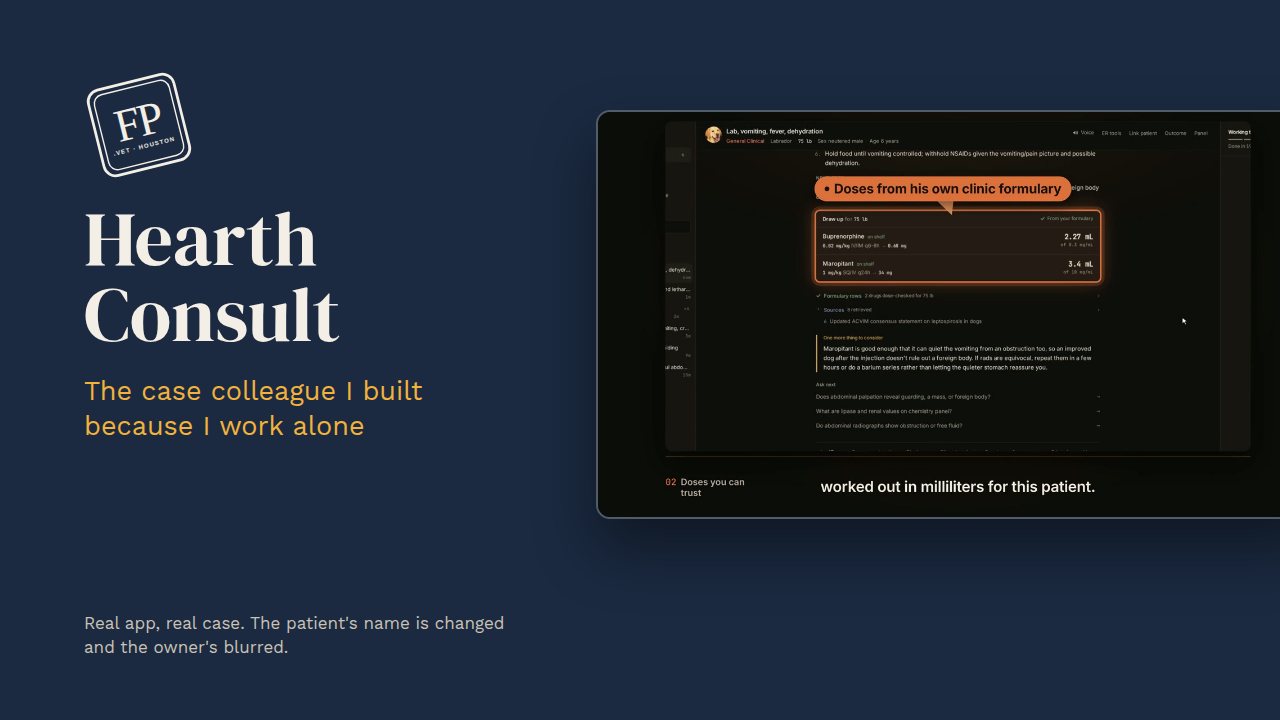
Hearth Consult is the colleague down the hall I never had. I type a case the way I’d say it, and it comes back with the bottom line, a ranked list of what it could be, and doses from my own formulary with the math checked in code. The first version took me a few hours with Claude. Here’s the whole thing in two and a half minutes.
Why would a vet build their own case consult?
If you’ve worked in a practice with three or four doctors, you know the move. Something doesn’t add up, so you lean into the next room and say, “Hey, look at this one for a second.” Half the time they don’t even solve it. Just saying it out loud to somebody who knows what you’re talking about is enough.
I’ve been the only doctor in my building for most of my career. When a case doesn’t add up, there’s nobody to lean over to. You figure it out yourself, usually while the next room fills up and a tech is standing in the doorway with a question about the dental.
I’d been using Claude for this for a while already, in a plain chat window. It was helpful, but it didn’t know my formulary, it didn’t know the patient, and I had to retype the whole history every time. So one day I asked Claude to build me the version I actually wanted. That took a few hours. I’ve spent a handful of evenings since then fixing the things that bugged me once I started using it on real cases.
What does it actually do?
I type the case like I’d say it to another vet. Dog, 75 lb, vomiting overnight, sore belly. The first words come back in about a second.
It leads with the bottom line, then a ranked list of what this could be, then the one question that would change the plan. That order was on purpose. I didn’t want a textbook chapter, I wanted the thing a good colleague does, which is tell you what they think and then ask you the question you forgot to ask yourself.
It’s a thinking partner first. It only gets into doses when a drug is actually part of the plan.
A few other things it does, all things I found myself wanting in the first week:
- Reads the short version out loud in George, the same voice narrating the video. Handy when my hands are full.
- Turns the plan into an owner handout in one click. Plain English, ready to print.
- Knows what’s on the shelf. If I tell it we’re out of something, it plans around that and remembers for next time.
- Has ER tools with no AI in them at all. A CPR timer with a metronome, drip and fluid math, and toxin checks for dogs and cats. On a bad day I don’t want a language model anywhere near a CPR count.
- Works on my phone, which is honestly where I use it most, standing at the treatment table.
How do you keep the drug doses safe?
This was the part I cared about most, and it’s the part I’d tell any vet building something like this to get right before anything else.
AI is good at reasoning through a case. It’s not good at arithmetic, and it will state a wrong number with total confidence. So the doses don’t come from the AI’s memory. They come from my own clinic formulary, the same one behind my drug calculator, worked out in mL for that patient’s weight.
Then the math gets checked again in plain code, outside the AI. If the words in the answer and the numbers ever disagree, the dose gets flagged and struck through on screen instead of trusted. Cats get hard stops on the drugs that hurt cats.
None of that replaces me reading it. It just means when something’s wrong, it’s loud about it instead of quietly wrong.
How does it read a real patient’s chart?
This is the part I’m proudest of. I type @ and the pet’s name, and it pulls the chart straight out of our practice software. Today’s exam, the history, the X-rays, all of it.
The owner’s name and contact details are stripped out before anything reaches the AI. The pet’s medical record goes in, because that’s the whole point, but nobody’s name or phone number does. If you’ve wondered where that line should sit, I wrote more about it in Is It Safe to Put Patient Records in an AI Chatbot?
Once it’s read the chart, the answer stops being generic. In the demo it’s a 15-year-old cat, and it’s working off that cat’s actual exam and radiographs from that morning. It also keeps a running whiteboard of the case on the side, so I can see what it thinks it knows and correct it when it’s wrong.
Can other vets use Hearth Consult?
Not this one. It runs on a little server in my clinic, it’s wired into my records and my formulary, and it’s just for me. There’s nothing to log into from out here, which is why the video is the tour.
But that’s really the point of showing it. I’m not a programmer. I’m a vet who got tired of the gap between what I wanted and what anybody was selling, and I asked Claude to close it. If you’ve got a version of this problem in your own clinic, the tools to build your own fix are sitting right there, and the first version probably takes you an afternoon, not a year.
If you want to see everything else that came out of that same habit, it’s all on the projects page. And if you build something, come show it off in the room. I’d love to see it.
Questions I get asked
- What is Hearth Consult?
- It's a case consult tool I built for my own clinic. I type a case the way I'd say it out loud and it comes back with the bottom line, a ranked list of what it could be, and the one question that would change the plan. It can pull a patient's chart from our practice software with the owner's name stripped out first.
- How long did it take to build?
- The first working version took a few hours with Claude. I've spent a handful of evenings since then fixing the things that bugged me once I used it on real cases.
- Can I buy it or use it?
- No. It runs on a little server in my clinic and it's just for me. I'm showing it because the point of this site is that a working vet can build this kind of thing, not because I'm selling it.
- Do you trust the AI's drug doses?
- Not on their own. The doses come from my own clinic formulary, and the math is checked in code, so if the words and the numbers ever disagree the dose gets flagged and struck instead of trusted. Cats get hard stops on the drugs that hurt cats. I still make the call.
- Does patient data go to the AI?
- The chart does, the owner doesn't. When I tag a patient, the owner's name and contact details are stripped out before anything leaves the building. The pet's history, exam and X-rays go in, because that's the whole point.
Tell me what's broken in your clinic.
If this made you think of a problem you'd fix, I want to hear it. Free, no spam, and I read every one.